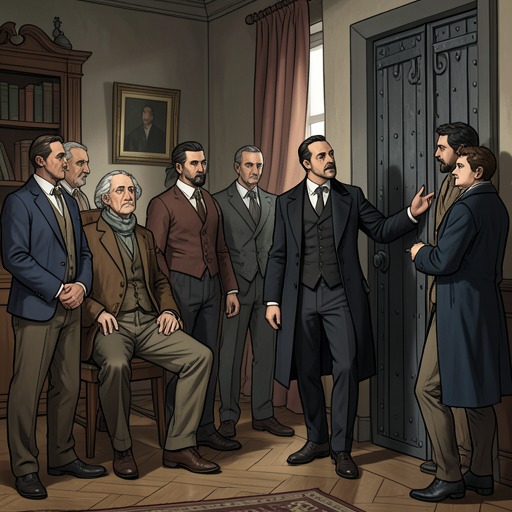
Charles Swann
In Search of Lost TimeCharles Swann remains consequential in these passages even when he is absent or dead: other people make him a test of loyalty, a disputed memory, a measure of social ascent, and a figure whose illness exposes the limits of friendship. His story is not simply recalled; it is repeatedly revised by the people who need to place him within their own social and political worlds.
Political Reputation and the Dreyfus Affair
Swann’s support for Dreyfus becomes a source of distress to the Duke de Guermantes, who regards him as an intelligent, cultivated man occupying a prominent position. The Duke finds it harder to accept Swann’s politics than the earlier Dreyfusard position of Saint-Loup: Saint-Loup, in his eyes, is a young man who has gone astray, whereas Swann is a level-headed figure whose standing makes his choice seem consequential. As the anti-Dreyfusard opposition grows more social and more intense, the Duke treats Swann’s position as a breach of an established public identity, not merely as a political disagreement.
The Duke’s complaint also turns Swann into an occasion for collective suspicion. Because Swann is Jewish and insists on supporting Jews in the Dreyfus affair, the Duke claims that his actions prove Jews are secretly united and obliged to support one another, even without personal ties. He presents a particular man’s political decision as evidence about an entire population, invoking the maxim “Ab uno disce omnes.” The episode shows how Swann’s individual judgment is absorbed into the period’s social polarization and made to serve an anti-Jewish generalization.
Swann’s account of his estrangement from the Prince de Guermantes gives the political disagreement a more intimate history. The Prince tells Swann that he had avoided him because he expected Swann’s views on the affair to be diametrically opposed to his own and could not bear to hear them expressed in his presence. He recalls the Princess challenging the Grand Duke of Hesse when the latter said Dreyfus was innocent, and describes her refusal to repeat that opinion to him. He also recounts how she answered the Crown Prince of Sweden, who mistakenly assumed she shared his Dreyfusard view, by declaring herself a French Princess who shared the views of her fellow countrymen. The Prince says that a conversation with General de Beauserfeuil later led him to suspect grave illegalities in the trial. Swann’s political commitment thus appears within a family and courtly world where even the discussion of the case had been carefully managed to avoid upsetting the Prince.
A Friendship Recalled at the Edge of Death
Swann tells the narrator that he is giving him the account of his conversation with the Prince because he has chosen him as a confidant, and hints that there is another reason the narrator will learn later. The narrator, in turn, longs to understand exactly what passed between the Prince and Swann and hopes to catch Swann before he leaves. Their exchange places the narrator in a position of partial knowledge: he hears Swann’s precise reconstruction of the conversation but is also told that its significance is not yet complete.
Swann’s illness brings the strain between old friendship and social obligation into sharper focus. The Duchesse de Guermantes says she has heard that he wants her to meet his wife and daughter before he dies. She expresses distress at his illness, but hopes it is not as serious as he says and resists the idea that impending death should itself compel an introduction. She argues that such a principle would make every dying person’s request binding, and admits that she would rather avoid Swann than risk having to refuse him. She remembers him as the most agreeable of her friends for fifteen years, yet describes his wife and daughter as the people who have deprived her of his company. Her attachment to Swann is real, but it does not overcome her reluctance to accept the family relationship his request would bring into view.
Memory, Society, and Changing Rank
Swann’s earlier association with Madame Verdurin’s circle becomes a point of dispute in later conversation. Brichot recalls Dechambre playing Vinteuil’s sonata for Swann when Swann was at odds with the aristocracy and had not yet become the Prince consort of Odette. Cottard contradicts him, insisting that the sonata was not played at Madame Verdurin’s until long after Swann had stopped attending. Brichot concedes that he may be mistaken. The disagreement makes Swann’s past part of a broader instability of social memory: the sequence of people, salons, and music is recalled differently by those who claim to know it.
Odette’s social ascent further changes how Swann’s history is understood. After his death, the Princesse de Caprarola visits Odette to offer condolences and asks whether she knows the Verdurins. Odette initially denies knowing them, then admits that she knew them years earlier; later she speaks as though she had known Madame Verdurin very well. Her answers expose both the older connection and her anxiety about its meaning in her new position. At a fashionable theatre rehearsal for a Bergotte play, Odette appears in the central box beside Mme de Marsantes and the Comtesse Molé, whose rise is also becoming conspicuous. Onlookers who had not realized Odette was climbing the social ladder see her arrival as evidence that she has reached its summit. Swann’s former world and his marriage remain part of the story of that ascent, even when society reads the visible signs through its own changing hierarchy.
The Social World Swann Leaves Behind
The changing history of Madame Verdurin’s salon is set against the unreliable prestige of other gatherings. Mme de Saint-Euverte’s parties appear, through newspaper society columns, to be among the leading events in Paris because their reports list prominent guests. In practice, those guests often attend only after entreaties and favours, feeling that their presence does honour to the hostess; a truly fashionable hostess may invite only a few people and avoid publicizing the list. This contrast clarifies the world in which Swann’s former salon affiliations are remembered: public accounts of society can make attendance look like intimacy and prominence, while the actual relations of invitation and status remain more selective.
The narrator also places Swann within the history of the Verdurins’ cultural ambitions. The salon is increasingly regarded as a Temple of Music, and Vinteuil’s name gains exceptional prestige even while his sonata remains largely unappreciated and little known. Young men of the Faubourg study music, and their mothers notice Madame Verdurin at concerts following the score. Against this later prestige, Brichot’s recollection of Swann hearing the sonata at the salon becomes more than a detail of chronology: it links Swann to an earlier phase of a circle whose cultural standing and social position continue to change.